Stocking a winter pantry when you cannot get to the store
Winter here lasts until May and there are weeks when the roads are not worth attempting. A pantry is not prepping, it is ordinary sense in a place with weather.
The principle
Stock what you actually eat. That is the whole thing and it is the rule everybody breaks.
A cupboard of things bought for an emergency, that nobody likes, will sit there until it expires and you will order a takeaway in the storm anyway.
Buy more of what you already cook. Rotate it. Eat the old and replace it.
The base
Flour, and more than you think. Bread flour and plain.
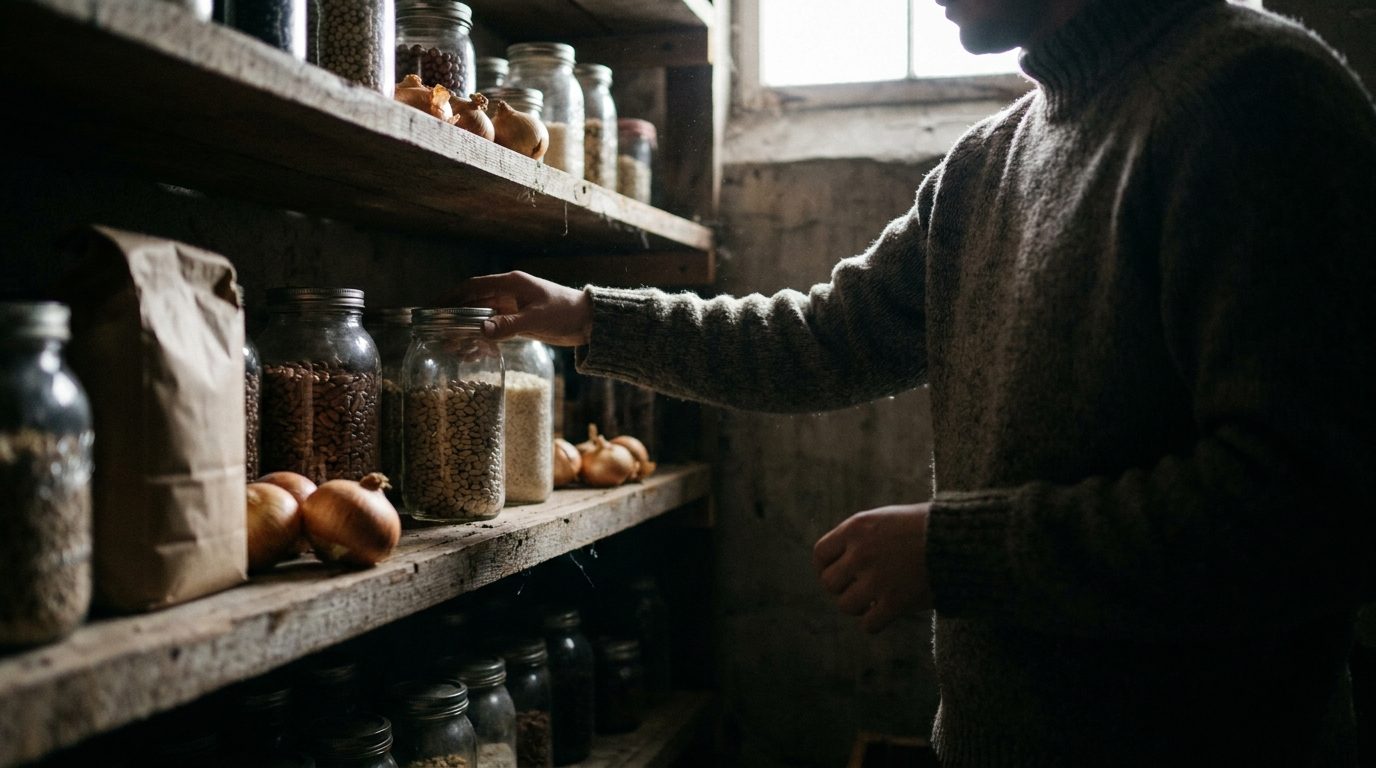
Rice, dried pasta, rolled oats, dried beans and lentils. These are the cheapest calories you can store and they keep close to indefinitely if they are dry and sealed.
Tinned tomatoes, tinned beans, tinned fish. Stock cubes or bouillon.
Oil, salt, sugar, yeast. Yeast keeps far longer in the freezer than in the cupboard and most people do not know that.
Vinegar, which is useful for more than cooking.
The things that make it food rather than fuel
Onions and garlic, which keep for months somewhere cool and dark.
Potatoes, carrots and cabbage, which keep for weeks in a cold garage or basement. Cabbage in particular keeps far longer than people expect and it is the vegetable that gets me through February.
Hard cheese, which keeps well.
Dried mushrooms, dried chilli, and a decent spice shelf, because a pantry meal is a starch plus a seasoning and the seasoning is what stops it being miserable.
Tinned or dried fruit.
And something to look forward to. Chocolate, good coffee, whatever yours is. This sounds frivolous and on day nine of being snowed in it is not.
The freezer
Bread, portioned. Stock, frozen flat in bags so it stacks. Meat in meal sized portions rather than one large piece.
Butter, which freezes perfectly.
Cooked meals in containers, which is the single best use of a freezer and which turns a bad week into an easy one.
Label everything with the date. You will not remember.
The power question
This is the part people in mild climates do not think about and we do.
A freezer that loses power keeps food frozen for about forty-eight hours if you do not open it, less if it is half empty. Fill empty space with containers of water, because frozen mass holds cold.
Keep some food that needs no cooking and no refrigeration. Tinned fish, crackers, nut butter, dried fruit.
Have a way to boil water that does not depend on the grid. A camping stove, used outside or in a properly ventilated space, never in a closed room.
And water. A gallon per person per day, for several days, particularly if you are on a well, because a well pump without power gives you nothing.
Rotation
Write the month on the lid or the bag when you buy it.
Put new stock at the back. This is the single habit that makes a pantry work and it takes two seconds.
Cook from it deliberately. I have a week in late February every year where I cook only from the pantry and the freezer, partly to use things up and partly to find out what is actually in there.
What I always run out of
Butter, every time.
And bicarbonate of soda, which I use constantly and never buy enough of.
Everybody has their own version of this and you will only learn yours by keeping a pantry for a couple of winters and noticing what you miss.
How much is enough
People either buy nothing or buy a pallet of something they will never eat, so here is a figure that is neither.
Two weeks of ordinary meals for everyone in the house, plus water for three days. That is a sensible target for most of the country and it is about right for a bad stretch here.
Two weeks is roughly fourteen dinners, fourteen breakfasts and something for lunch, which sounds enormous and comes to a surprisingly small pile once you write it down. Work it out as meals rather than as a list of ingredients and you will not over buy.
If you are somewhere genuinely remote, or at the end of a road that does not get ploughed early, extend it to a month on the dry goods and keep the fresh element the same.
What keeps, and for how long
Dried beans, rice, pasta and rolled oats keep for years if they are dry and sealed. Put them in airtight containers rather than the bag they came in, because the bag is not airtight and mice are better at this than you are.
Flour keeps six months to a year in the cupboard and much longer in the freezer. Wholemeal flour goes rancid faster than white because of the oil in the germ, so buy it in smaller quantities.
Tinned goods are good well past the date on the tin, which is a quality date rather than a safety date, provided the tin is not swollen, rusted or dented on a seam. Those three are the things to look for.
Oil goes rancid. Buy the size you will use in six months, not the largest one.
Yeast in the freezer keeps for years. Yeast in a warm cupboard is dead by spring.
Spices do not spoil, they just fade. Replace anything you cannot smell when you open it.
Rotation is the whole thing
A pantry that is not rotated is a cupboard of expired food that made you feel prepared.
Write the month on the lid with a marker when you buy it. New stock goes behind the old. That is the entire system and it takes two seconds a shop.
Cook from it deliberately once a season. I do a week in late February where nothing comes from the shop, which uses things up before they turn and shows me what I actually reach for.
Every household has a thing it always runs out of. Mine is butter and bicarbonate of soda. You will only find out what yours is by keeping a pantry for a couple of winters and paying attention to what you miss.