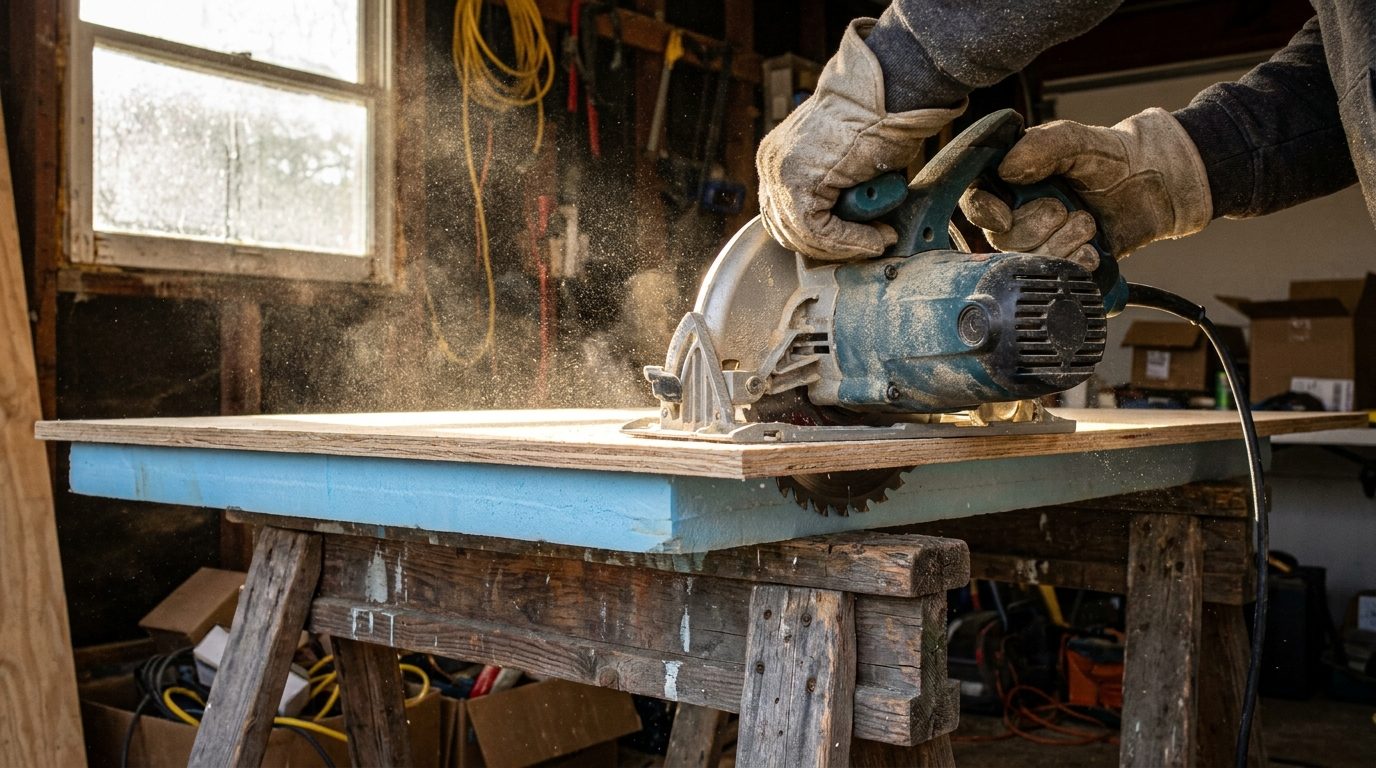
Safe ways to use a circular saw for home projects
A circular saw is the most useful power tool a homeowner can own and the one that hurts the most people. Forty-one years and I still respect it more than any other tool in the van.
Set up before you cut
Support the work on both sides of the cut, and support it so the offcut cannot pinch the blade.
That is the whole cause of kickback. The two pieces close on the blade, the blade grabs, and the saw comes back at you fast.
Sawhorses with a sacrificial sheet of rigid foam underneath is the best method for sheet goods. The foam supports everything, the blade cuts a fraction into it, and nothing drops or pinches.
Never cut a board held between two sawhorses with the cut in the middle. That is the classic pinch setup and it is how a great many people learn about kickback.
Never hold the work with one hand and cut with the other. Clamp it.
Blade depth
Set it so the blade projects about a quarter of an inch below the material. No more.
Less blade exposed means less to catch you if something goes wrong, and it means the teeth enter the wood at a better angle with less tendency to grab.
People run the blade at full depth because it is quicker to set and it is the wrong habit.
The guard
The lower guard retracts as you cut and springs back when you finish. It must move freely.
Do not tie it back. Do not wedge it. If it is sticky with resin, clean it.
The number of injuries that involve a saw set down while still spinning with a guard that did not close is not small.
Body position
Stand to the side of the blade, not directly behind it. If it kicks back, it comes straight back along the line of the cut, and you do not want to be there.
Feet planted, not reaching. If you have to stretch to finish the cut, stop and reposition.
Both hands on the saw where the design provides for them.
And watch the cord. Running over your own cord is common and it can be more than an inconvenience.
Blade choice
A sharp blade with the right tooth count for the job. A dull blade requires force, and force is how mistakes happen.
Fewer teeth for ripping along the grain, more teeth for crosscutting and for sheet goods.
Check the blade is on the right way round. The teeth point in the direction of rotation, which on most saws means pointing up at the front. It sounds too basic to mention and I have seen it done wrong by people who should know better.
Making the cut
Let the blade reach full speed before it touches the wood.
Steady feed. Do not force it, and do not stop halfway through unless you have to. If you do stop, let the blade stop before lifting it out.
Guide with a straight edge clamped to the work for anything that has to be accurate. Freehand is fine for rough cuts and it will never be straight over eight feet.
Watch the line, not the blade. The saw follows your eyes.
Afterwards
Let it stop before setting it down. Every time.
Unplug or remove the battery before changing the blade, and before clearing a jam.
The things I actually wear
Eye protection, always, without exception.
Hearing protection, which I did not wear for the first fifteen years and which I regret, because I now have the hearing of a man who did not wear it.
A dust mask for anything treated or manufactured.
No gloves. This is contentious and I feel strongly about it. Loose gloves near a spinning blade are worse than bare hands.
No loose sleeves, no jewellery, and hair tied back.
That list costs about forty dollars and it is the cheapest part of the whole job.