Why you should never start a plumbing repair on Sunday afternoon
The supply houses are shut, the hardware shop closes at four, and every plumber in town is either off or charging emergency rates.
That is the whole argument and forty-one years in the trade taught it to me the hard way.
What actually goes wrong
You start a small job. Replace a tap, change a shut off valve, swap a length of pipe.
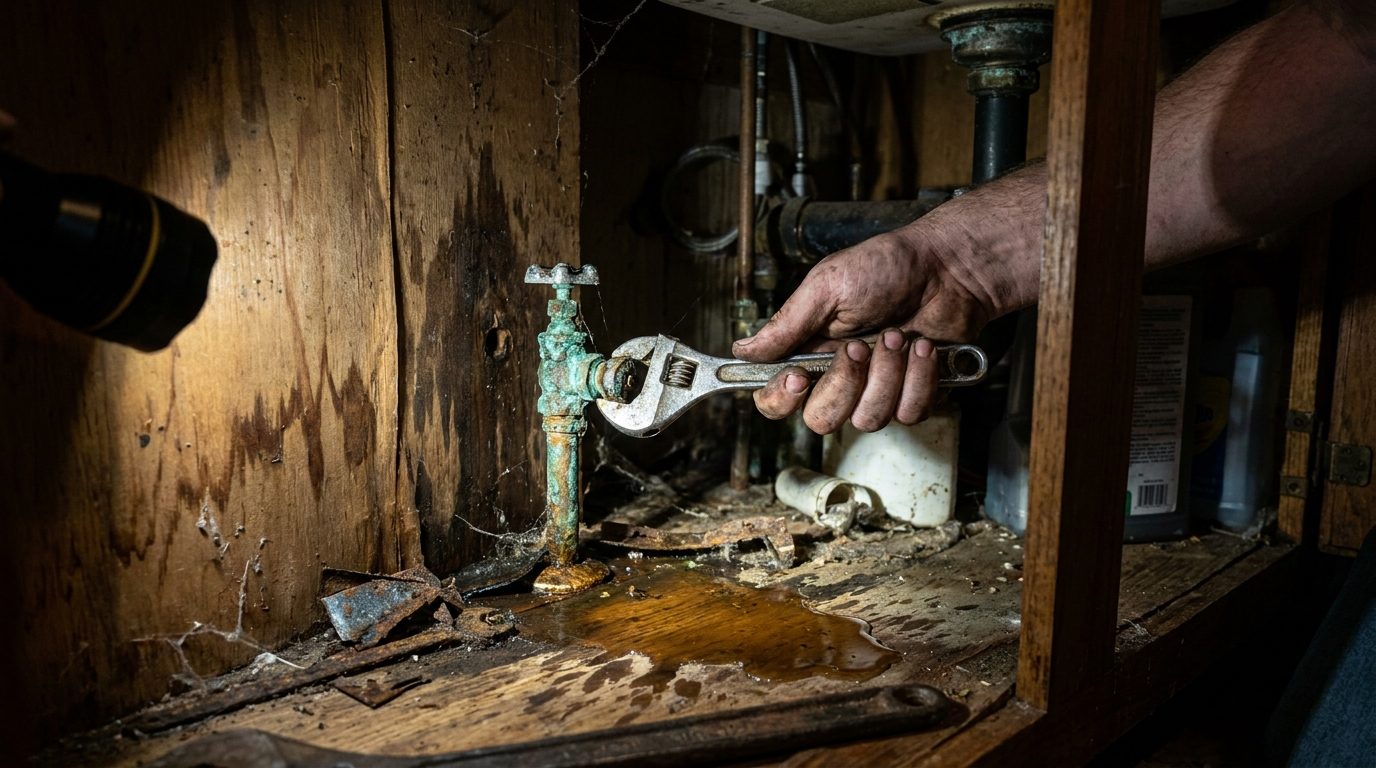
Then something that should turn does not turn. A fitting that has been in place since 1978 and has effectively welded itself.
Or the shut off valve you are relying on does not shut off. Old gate valves fail closed and they fail open, and the ones nobody has touched in twenty years fail more often than they work. Now you are looking for the main.
Or you get the old part out and discover the replacement is the wrong thread, the wrong diameter, or the wrong material to join to what is there.
Any one of those turns a forty minute job into a job that needs a part you do not have, and it is half past two on a Sunday.
The rule I worked to
Never open a system you cannot close.
Before you undo anything, find the shut off and test it. Turn it off, open the tap, and confirm the water actually stops. Then turn it back on and check the valve does not weep afterwards, because old valves that have been moved sometimes will not reseat.
Know where the main shut off is for the whole house, and make sure it turns. Do this on a Tuesday, not during a flood.
If you have a well, know where the pump breaker is.
The other rule
Buy the parts before you start, and buy more than you need.
Extra washers, extra fittings, thread tape, a spare supply line. The supply line is the one that catches people, because you will not know the length you need until the old one is off.
Returns are easy. A Sunday evening without water is not.
The seized fitting
This is the single most common thing that ends a domestic plumbing job.
Penetrating oil and time. Apply it and go away for an hour, which nobody wants to do and which works.
Two wrenches, always. One holding the part you do not want to move, one turning the part you do. Turning a fitting with a single wrench twists the pipe behind it and that is how a small job becomes a wall opening job.
Heat, carefully, and not near anything flammable and not on anything plastic.
And know when to stop. A galvanised fitting from the 1950s that will not move is telling you something, and forcing it snaps the pipe inside the wall.
When to call somebody
Anything inside a wall or under a slab.
Anything involving the main, the water heater's gas or the sewer line.
Anything where you cannot isolate the water.
And anything where you have already made it worse, which is not shameful. A plumber arriving to a job that has been started badly would rather be called at that point than two hours later.
When I would actually do it
Saturday morning. Early.
The supply house is open, the hardware shop is open, and if it goes wrong you have the whole day and a plumber who is working normal rates.
I did a tap change for a neighbour last spring that should have been twenty minutes. The shut off failed, the compression fitting was corroded solid, and I needed a part nobody stocks. It was finished by two in the afternoon and she had water the whole time, because we started at eight.
Had we started at one on a Sunday she would have spent the night at her daughter's.
Measure twice, and start early. Those are the same principle applied to different things.