Repairing drywall holes so they actually disappear
The reason most patches show is not the filling. It is that people stop too soon on the feathering and then paint over an edge you can see in raking light.
The size of the hole decides the method, so start there.
Small holes, up to about half an inch
Nail holes, screw holes, anchor holes.
Push the compound in with a putty knife, slightly proud, let it dry, sand flush. Two thin coats beats one thick one because thick compound shrinks and cracks.
For an anchor hole, tap the edges in gently with the handle of a screwdriver first so there is no raised lip around it, then fill.
Medium holes, up to about six inches
This is the doorknob through the wall, and the self adhesive mesh patch is made for it.
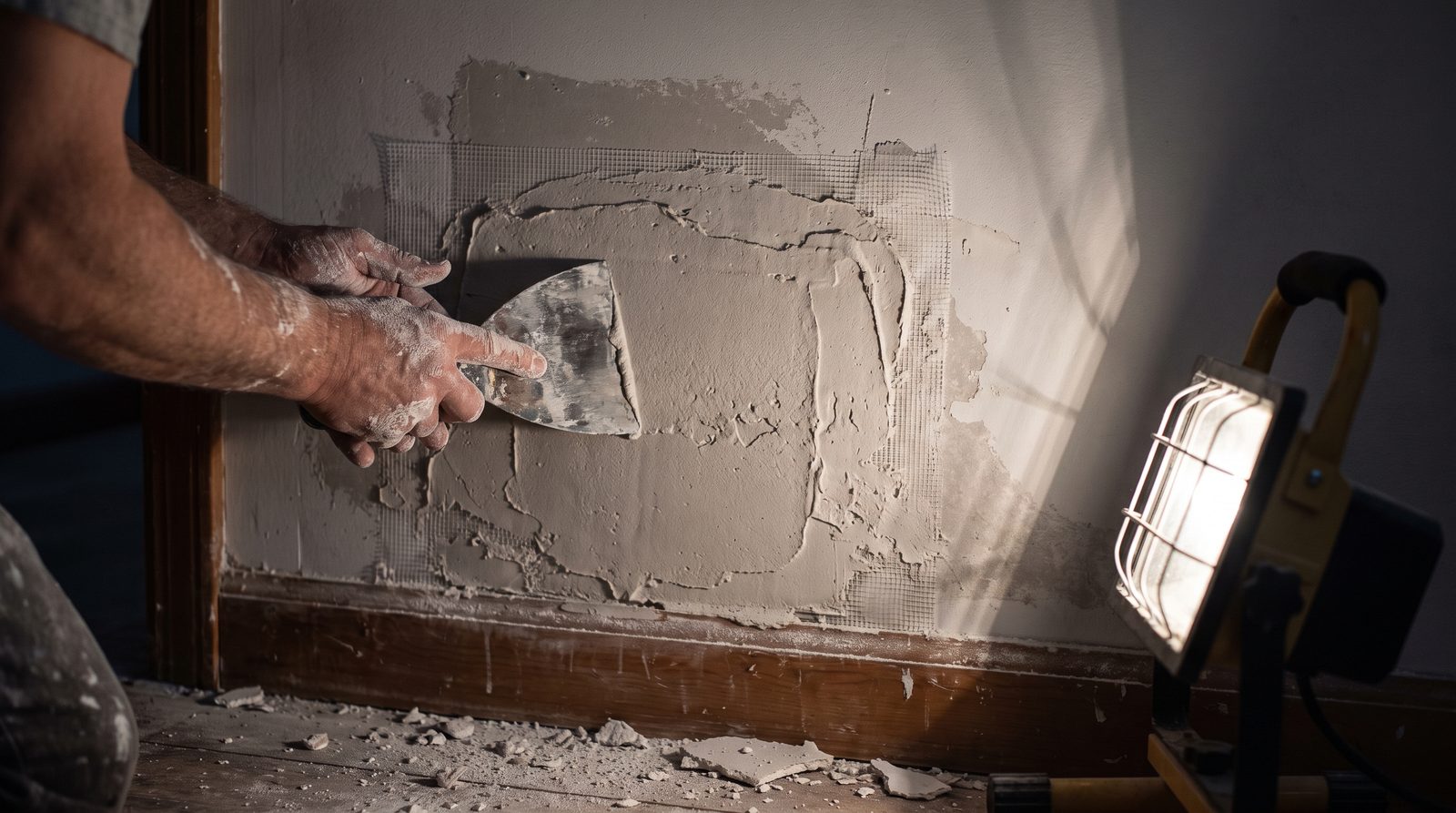
Stick the patch over the hole, then apply compound over it in three coats, each one wider than the last. First coat covers the mesh. Second coat about eight inches across. Third coat about twelve.
Thin coats. If you can see the outline of the patch under your third coat, you have not gone wide enough.
Large holes
Cut it square. This feels wrong, making a bigger hole, and it is the right move, because a square hole takes a square patch.
Find the studs on either side. If you can cut back to the centre of two studs, the patch screws directly to them and you are done.
If not, use the backing method. Cut a piece of scrap timber longer than the hole, slide it in behind the drywall, and screw through the existing wall into it at top and bottom. Now you have something to screw the patch to.
Cut a piece of drywall of the same thickness to fit the hole, screw it to the backing, tape the four seams with paper tape or mesh, and then three coats of compound, feathering wide.
Check the thickness. Half inch is standard for walls and five eighths is common on ceilings and in some newer construction. A patch of the wrong thickness will never disappear.
The three things that give a patch away
Not feathering far enough. The final coat should be a foot or more across for anything but a nail hole. A patch is invisible because the transition is gradual, not because the filling is perfect.
Sanding too aggressively. You want to knock down the high spots, not dig into the paper of the surrounding wall. Fine grit, light pressure, and a sanding sponge rather than a block for the edges.
Skipping primer. Compound is porous and paint soaks into it differently from the surrounding painted wall, so even a perfect patch shows as a dull spot. Prime the patch before painting.
Texture
If the wall is textured, and most are to some degree, a smooth patch stands out no matter how well it is feathered.
Spray texture in a can works for orange peel and knockdown if you practise on cardboard first. Getting the nozzle distance right takes three or four attempts and it is worth doing them.
For a hand applied texture, match it with a sponge, a brush or a knife. Look at the existing wall closely and work out how it was made.
Then prime and paint.
Paint
Paint the whole wall corner to corner if you can. A touch up in the middle of a wall almost always shows, because paint fades and the sheen changes over time, and the new paint will not match even from the same tin.
If you cannot repaint the wall, feather the paint out from the patch rather than cutting a hard edge, and accept it may be visible in certain light.
How long it takes
Longer than people expect, because of drying time between coats.
A proper patch is three visits to the wall over two days, each taking ten minutes. People try to do it in one afternoon, which means thick coats, which means shrinkage and cracking.
Do the first coat in the morning, the second in the evening, the third the next morning, sand at lunch and paint in the afternoon. That is the actual schedule and it produces a patch nobody finds.