How to clean and season your only cast iron pan
Cast iron has accumulated more folklore than any other kitchen object, and most of it makes people afraid of a pan that is nearly impossible to ruin.
Here is what is actually true, from a pan I have used daily since 2016.
You can use soap
This is the myth that will not die.
The prohibition dates from when soap was made with lye, which would strip the seasoning. Modern washing up liquid is a detergent and it will not.
A small amount of soap, a brush or a non scratch pad, warm water. The seasoning is polymerised oil bonded to the metal and it is not coming off because you washed the pan.
What you should not do is soak it, or put it in the dishwasher, or leave it wet. Those cause rust, which is the actual enemy.
The routine after cooking
Wash it while it is still warm. Not screaming hot, which can warp it if you hit it with cold water, and not stone cold, when everything has set hard.
Stuck on food comes off with coarse salt as an abrasive and a little water, scrubbed with a paper towel or a brush. Or put water in the pan and bring it to a simmer for a couple of minutes, which lifts almost anything.
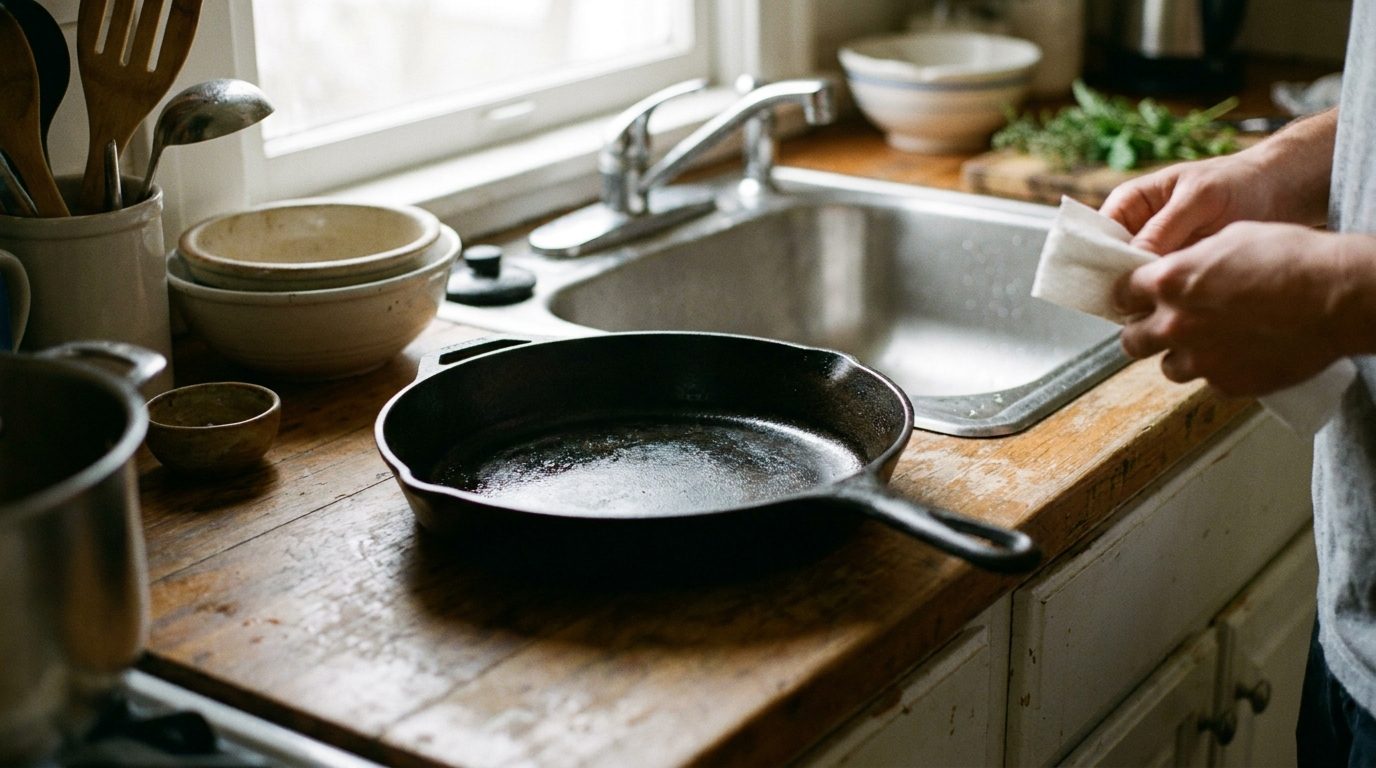
Then dry it completely. Towel, then back on a warm burner for a minute so the last of the moisture evaporates.
Then a very small amount of oil. Wipe it over the whole surface and then wipe it off again, so it looks almost dry. Too much oil is what makes a pan sticky and tacky, and that is the most common complaint people have.
That is the entire routine and it takes ninety seconds.
Seasoning, when you need it
You do not need to re-season a working pan after every use. Cooking in it is what maintains the seasoning.
You re-season when it is patchy, dull, rusted, or after you have had to scrub something badly.
The method. Clean it thoroughly, dry it completely, apply a thin film of a neutral oil with a high smoke point, wipe it back until it looks dry, and bake it upside down in the oven at around 450 for an hour with something underneath to catch drips. Let it cool in the oven.
Repeat if you want a stronger layer. Thin coats, several times, beats one thick coat, which goes sticky.
Rust
Not a disaster. Scrub it off with steel wool, which people are afraid to do and which is correct here, down to bare metal if necessary.
Then wash, dry, and season as above.
A pan that has been left in a barn for twenty years can be brought back. This is why people buy them at yard sales.
What actually harms it
Standing water. Leaving it wet, or soaking it, or putting it away damp.
The dishwasher.
High acid foods cooked for a long time in a new or thin seasoning. Tomato sauce simmered for two hours in a freshly seasoned pan will strip patches of it. In a well established pan it is fine, and I make tomato sauce in mine regularly.
Extreme thermal shock, which can crack it. Do not put a screaming hot pan under a cold tap.
Metal utensils
Fine. Use them.
A metal spatula does not damage a well seasoned pan, and in fact scraping with one is part of how a cooking surface stays smooth.
The one pan argument
If you have one pan, a ten or twelve inch cast iron skillet is the one I would keep.
It sears, it fries, it goes in the oven, it bakes bread, it makes a frittata. It costs very little and it will outlive you.
The only things it does poorly are anything where you want to see the fond clearly, and long simmered acidic sauces in a poorly seasoned pan.
Mine is nine years old, black, smooth, and I have never done anything to it beyond what is described above.